
Introduction
To answer the question of why VXLAN was even invented, let's have a look at what problems it's trying to address.
First of all, if you try building a standard Layer two Clos topology like this, you will end up with STP which comes with two drawbacks
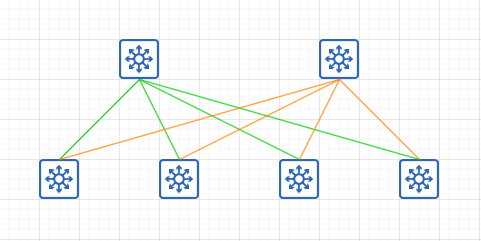
- Roughly half of your links are going to be blocked to avoid loops (which is only part of a problem)
- Relatively high convergence time
So what what can we do to address those issues ? - Implement Layer 3 routing throughout the core. And yes, in most of the cases that would have been an elegant solution allowing for Equal Cost Multi Path routing while keeping the core loop free. But it comes at a cost as you will no longer be able to share broadcast domains between the access switches and, in some cases, that becomes a requirement (think vMotion)
To address that issue (along with L2/L3 segregation which comes from EVPN) another encapsulation type was invented and called VXLAN